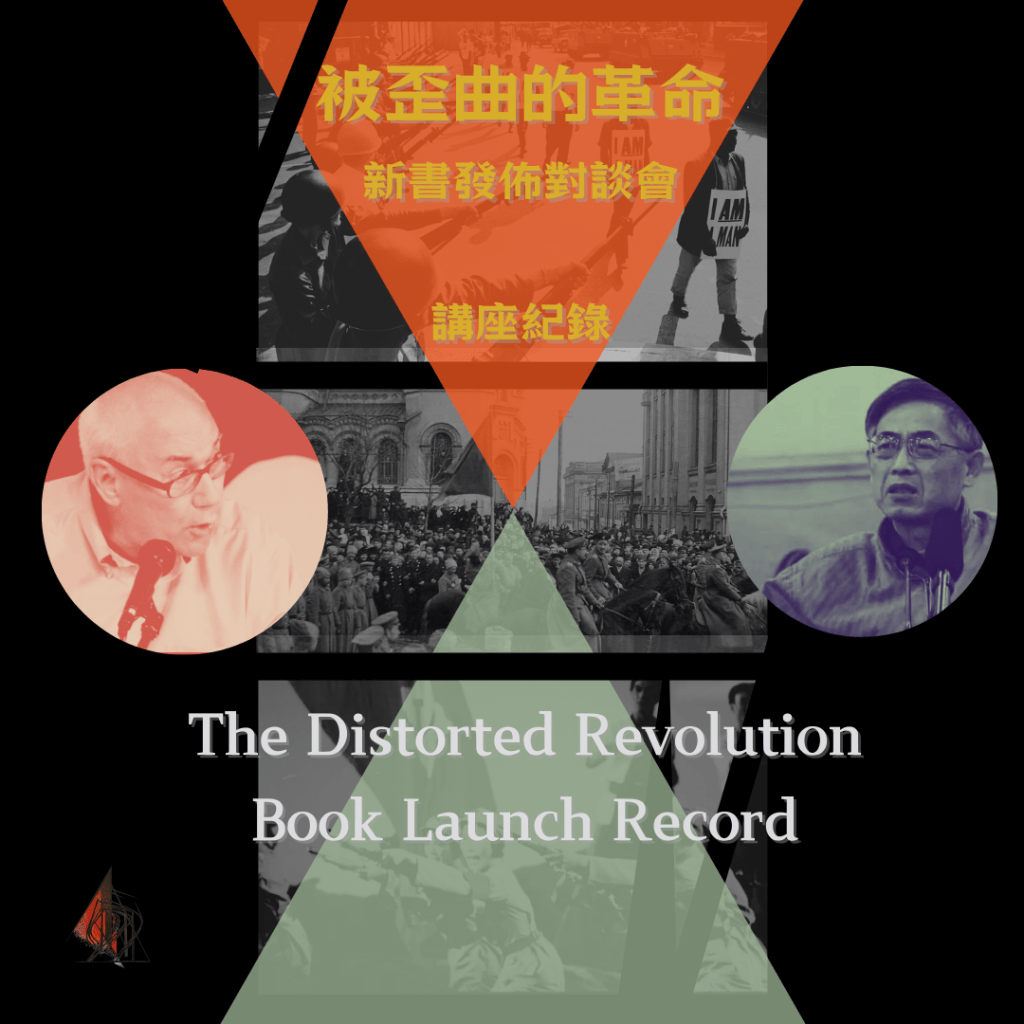
《被歪曲的革命》新書發佈會紀錄
The Distorted Revolution Book Launch Record
在2024年11月20日舉辦的《被歪曲的革命》新書發佈會上,托洛茨基譯者施用勤與美國歷史學家保羅·勒布朗教共同探討了中美在左翼研究及國際共產運動中的歷史與現狀。施用勤先生講述了他在社會主義中國的成長經歷,以及對主流意識形態的批判,這促使他投身於托洛茨基思想的翻譯與研究。保羅·勒布朗教授則分享了他在1960年代參與各類社會運動的經歷,並強調了這段時期對於當代社會運動的重要性。
此次對談不僅涉及兩位學者各自的個人歷程,還探討了中美社會知識分子在唯物主義及其美德標準方面的不同觀點。施先生指出,托洛茨基的思想為中國社會史提供了重要的理論資源,而勒布朗教授則強調了馬克思主義在當今社會運動中的實踐意義。
整場對話深入剖析了歷史、官僚體制及革命等複雜情境如何塑造了20世紀及其後的發展,並為參與者提供了一個反思當前社會運動和思想潮流的平台。這次活動不僅是對新書的介紹,更是一次跨文化、跨國界的思想交流,旨在促進對於左翼思想及其未來發展的深入理解。
On November 20, 2024, the book launch of Distorted Revolution featured a compelling discussion between Shi Yongqin, a translator of Trotsky’s works, and American historian Paul LeBlanc. They explored the historical and current state of leftist studies and the international communist movement in both China and the United States.
Mr.Shi shared his experiences growing up in socialist China and his critiques of mainstream ideology, which led him to dedicate himself to translating and studying Trotsky’s thought. He emphasized that Trotsky’s ideas provide crucial theoretical resources for understanding Chinese social history. In contrast, Professor LeBlanc recounted his involvement in various social movements during the 1960s, highlighting the significance of that era for contemporary social activism.
The dialogue not only delved into their personal histories but also examined differing perspectives among intellectuals in China and the U.S. regarding materialism and its virtues. Shi noted that Trotsky’s thoughts are vital for understanding socialism’s true essence, while LeBlanc underscored the practical implications of Marxism in today’s social movements.
This engaging conversation dissected how complex contexts such as history, bureaucratic systems, and revolutions have shaped developments in the 20th century and beyond. It provided participants with a platform to reflect on current social movements and intellectual trends. The event served not only as an introduction to the new book but also as a significant cross-cultural exchange of ideas aimed at fostering a deeper understanding of leftist thought and its future trajectory.
Scroll down for the English transcript.
主持: 先請施老師分享一下您的經歷。
施用勤: 我走向托洛茨基是一個複雜的過程。在我們那個時代,對待史達林和托洛茨基這樣的重大歷史人物有著截然不同的態度:人們對史達林都是讚美的,而對托洛茨基則都是否定的。那時候,想要從事這方面的研究是不被允許的,也沒有相應的條件。
在我農村插隊的時候,除了幹農活以外,還想學點東西充實自己。當時我學習俄語並沒有什麼特定目的,只是單純地想著將來如果有機會的話,能夠閱讀俄文小說原著。因為俄國有許多偉大的小說家和不朽的文學作品,所以我就是出於這個簡單的想法開始自學俄語的。
開始學習俄語時,我並沒有明確的實際方向和目標。隨著自己的俄語水準提高,我萌生了想當翻譯的念頭。當然,我希望能翻譯一些有價值的作品。但是那些著名的俄國小說家的偉大作品,早已被前人翻譯完了。作為一個新手,我也沒有資格去重譯這些經典作品。
後來我看到了托洛茨基的自傳。雖然之前我沒有機會深入研究這方面的內容,但通過觀看《列寧在1918》等電影,以及親身經歷史達林體制下的社會現實,包括中國社會中的一些現象,我感覺這些都與真正的社會主義理念格格不入。讀完托洛茨基的自傳後,我過去對蘇聯黨史的諸多疑問,以及對某些打著社會主義旗號所行之事的質疑,都得到了解答。
從那一刻起,我決定把翻譯托洛茨基的著作作為自己的畢生事業。托洛茨基的自傳是我翻譯的第一本托洛茨基作品,也是中國第一本公開出版的托洛茨基著作。此前雖然也出版過一些托洛茨基的著作,但都是內部發行。我為這本書寫的譯者前言,是中國大陸第一篇正面評價托洛茨基的文章。
托洛茨基的自傳只記述到他1929年被驅逐到土耳其為止,因為該書是在1930年出版的。我覺得有必要整理一部托洛茨基的完整傳記,於是後來通過上海的鄭超麟老先生聯繫,拿到了他組織翻譯的翻譯伊薩克·多伊徹的《先知三部曲》。第三卷是我組織翻譯的。由於譯文品質問題,第一版我整整校對了六遍。
在此本書的校對過程中,我對照原文反復閱讀了六遍,每次閱讀都令我深受感動。特別是他分析德國共產黨在反法西斯鬥爭中的錯誤政策時,以及他對第三時期理論和社會法西斯理論的尖銳深刻的批評,都讓我讚歎不已,擊節讚歎。
從《先知三部曲》的翻校經歷中,我確定了自己的翻譯重點。因為托洛茨基首先是一個革命家,所以我首先關注他指導的革命實踐。雖然我還沒有翻譯他關於西班牙革命的著作,但我先後翻譯了他關於十月革命的文集《托洛茨基親述十月革命》。之後,我又陸續翻譯了《托洛茨基論中國革命》和《托洛茨基論反法西斯鬥爭》這兩部作品。
值得一提的是,《先知三部曲》在中國大陸受到廣泛好評,去年已經出了第三版。我剛才提到的三本書:《托洛茨基親述十月革命》、《托洛茨基論中國革命》和《托洛茨基論反法西斯鬥爭》都由陝西人民出版社出版。特別是後兩本書在豆瓣上的評分很高,《論中國革命》得到8.9分,《論反法西斯鬥爭》更是獲得了9.7分的高分。
我認為1920年代蘇聯共產黨的黨內鬥爭是共產國際歷史上的轉捩點。這場鬥爭導致了史達林體制的形成,也是社會主義國家官僚體制的起源。實際上,托洛茨基被驅逐出國,某種程度上也意味著馬克思主義被驅逐出蘇聯。此外,我還翻譯了英文版《左派反對派的挑戰》三卷本,以及《托洛茨基論過渡時期的文化》和《托洛茨基論社會主義經濟建設》。目前正在進行的是托洛茨基最後流亡期間的十四卷文集的翻譯工作。
我之所以能夠把翻譯托洛茨基的作品當作畢生事業,與我們那個時代接受的教育有關。我們相信共產主義社會是人類發展的必然方向,是人類最美好的社會形態。雖然我也寫一些文章,但那只是翻譯工作的副產品,我始終以翻譯為主。
主持: 感謝施用勤老師的分享。現在我們邀請保羅·勒布朗教授來分享他的經歷和見解。
保羅·勒布朗:我很榮幸能參與這次討論,並向組織此次活動的朋友致敬。我認為這可能是各國之間展開重要交流與分享的開始。談談我的經歷——我出生於1947年。我的父母是左翼工運活動家,曾在20世紀30年代和40年代是美國共產黨的成員。
我在美國成長的年代,正值資本主義制度相對繁榮之時,政治氛圍充斥著冷戰反共思想。在我成長的賓夕法尼亞州小鎮上,這種情況尤為明顯。那時,我受到美國作為民主共和國的理想所激勵,這個理想應該為所有人提供自由與正義。然而,我發現現實遠不如我們所相信的那樣自由、公正和民主。
在我試圖理解周圍現實的過程中,最初受到的影響包括各種社會鬥爭和運動,例如我父母所參與的工人運動,尤其是美國的工會運動;還有不斷發展的反種族主義鬥爭和民權運動。
隨後,反戰浪潮和日益壯大的運動出現。面對核戰爭的威脅,人們展開抗議。美國政府支持右翼獨裁者,在拉丁美洲、中東、非洲和亞洲進行軍事幹預。
最重要的是越南戰爭,我從青少年時期便目睹了它的發展,並積極參與反戰運動。後來,我瞭解了蘇聯和東歐持不同政見的詩人、作家及知識分子。我受到中國革命的影響,感受到毛澤東思想的衝擊。古巴革命也對我產生了啟發。
對我產生具體思想影響的是幾個來源。其中有維克多·謝爾日(Victor Serge)的一本書,他曾是一位俄國革命者,是托洛茨基領導的左派反對派成員。他寫了一本名為《俄國二十年後》的書,於1937年出版。我母親在年青時購買了這本書,但因受史達林主義影響,她將書擱置在我祖母家裡。多年後,我在那裡發現了這本書,它成為我影響深遠的一部著作。
激進社會學家C·賴特·米爾斯(C.Wright Mills)的著作也對我產生了影響,他寫過關於美國權力精英及其他議題的著作,其中有一本叫《馬克思主義者們》,這本書讓我認識了各種馬克思主義者及其著作和思想。通過這本書,我認識了艾薩克·多伊徹(Issac Deustscher),開始閱讀他寫的《史達林傳》,然後又讀了他的《托洛茨基傳》和其他著作。
我的父母為家裡帶來各種左翼出版物;家裡訂閱了一份名為《每月評論》(Monthly Review)的雜誌,由保羅·斯威齊(Paul Sweezy)和列奧·胡伯曼(Leo Huberman)主編,後來由哈里·馬格多夫(Harry Magdoff )主編。這是一份獨立的馬克思主義雜誌,在某種程度上受到毛澤東思想影響,但對我產生了重要影響。家裡還有另一份期刊叫《進步派》(The Progressive),這是一份左翼自由主義雜誌,以及一份名為《國民衛報》(The National Guardian)的左翼週刊,也對我有影響。後來,我自己訂閱了一份名為《新政治》(New Politics)的左翼社會主義雜誌。這些都是我在青少年後期受到的一些思潮影響。
再往後,我受到歐內斯特·曼德爾(Ernst Mandel)的影響,他是比利時一位傑出的馬克思主義經濟學家和作家,也是托洛茨基主義者。另外還有喬治·布萊特曼(George Breitman),他編輯過馬爾科姆·X(Malcolm X)的著作,也編輯過托洛茨基的作品。我有幸認識曼德爾和布萊特曼,他們成為我的導師,我也受到其他各種馬克思主義著作的影響。
我考慮過加入社會黨和共產黨的青年團體,但最終沒有加入,而是成為新左派的一員,加入了一個名為「民主社會學生會」(Students for a Democratic Society, SDS)的組織,該組織的意識形態更加開放和模糊。在某個時候,我覺得這還不夠,因此加入了美國社會主義工人黨(Socialist Workers Party in the United States),該組織隸屬於第四國際——一個全球托洛茨基主義政黨網絡[1]。
這些經歷為我提供了連貫的思維方式和有紀律的社會實踐,以及對馬克思主義中托洛茨基主義理解——它具有國際主義特徵,致力於革命民主和革命社會主義,同時保持批判思維。這些都是我走向托洛茨基主義過程中的重要影響。
主持: 感謝保羅的分享。施用勤教授有什麼要補充的地方嗎?
施用勤: 我覺得我和勒布朗教授之間有明顯的差別。他在社會環境的影響下,有機會接受多方面的影響,包括社會影響、歷史影響以及社會團體的影響。而我是在將近40歲(37或38歲)時才開始接觸托洛茨基的著作並開始翻譯工作。勒布朗教授的視野比我寬廣得多,他親身參與社會運動,而我只是一個半路出家的翻譯者。我認為自己最有價值的工作就是翻譯托洛茨基的著作。雖然有人勸我寫作,但我覺得自己寫的不如托洛茨基寫的好。
保羅·勒布朗: 我對施先生分享的他的經歷感到非常震撼,也對他參與的、成就的印象深刻,他所做的工作極其重要。我們的經歷有所不同,涉及不同的方面和特點,這是可以理解的,因為我們在非常不同的文化和環境中成長。
當我在武漢參加關於羅莎·盧森堡的會議,以及後來的列寧國際會議時,我有機會接觸到許多各年齡層的學者,特別是年輕的學者,還有那些正在探索和提出批判性問題的,都讓我感到非常興奮——這些都是非常重要的。施先生為中國的後起之秀提供了極重要的資源。所以我很高興認識他,我非常敬佩和尊重他所做的工作。
主持: 作為年青一代,我們對兩位的經歷都有所共鳴——我們有機會接觸到不同的思想資源,這些資源塑造了我們對社會和歷史的理解。比如説是中國歷史是我們課程的重要組成部分。此外,賴特·米爾斯的《權力精英》也是我們社會學課程中的經典讀物,為我們提供了對社會權力結構的深刻見解。儘管有這樣結構化的學習方式,許多人常常對教育內容感到不滿。這種感覺促使一些學生探索托洛茨基主義及其對中國歷史的解讀。像施先生這樣的學者的著作對我們理解香港和中國大陸當前社會政治格局的複雜性起到了重要作用。我們認為,香港是中國未完成革命的產物,這為我們的學習增添了一層歷史意義。這種視角使我們能夠在中國和美國之間進行有趣的比較,認識到塑造這兩個社會的各種影響。
施用勤: 托洛茨基的論證方法非常嚴謹。通過翻譯他的作品,我也學習到了這種嚴謹的論證方式,這影響了我自己的寫作風格。因此,我的文章也保持著相當的嚴謹性。
在國內黨史研究界,學者們似乎只能接受到布哈林為止的觀點,對托洛茨基的觀點是完全排斥的。我原本以為我的文集不能出版是因為新聞出版署的審查,後來才知道是因為中央編譯局的審稿人員都是布哈林派,他們根本不接受託洛茨基的觀點。更令人遺憾的是,他們既不說明不能出版的原因,也不願意公開辯論。
主持: 在這裡我們可以看到,對於中國學者來說,爭辯並不是目的本身;相反,它是一種實用的方法論,用來確定中國應該走的方向。這不僅僅是辯論,而是幾乎成為了一種治理和革命的途徑。當某些歷史事件被討論時,它們往往超越了單純的歷史,具有方法論上的重要性。問題變成了:我們實際上與哪一種思想流派(即該怎麼做)保持一致?這種觀點使得像施先生這樣的作家難以在中國發表作品。
施用勤: 所以說,一個理論只要足夠徹底就能說服人。一篇文章如果有充分的史料支撐,邏輯論證嚴謹,闡述的是事實,那麼它就具有無可辯駁的說服力。
回顧托洛茨基在黨內鬥爭中失敗的原因,可以看到一個鮮明對比:托洛茨基是在進行思想理論層面的鬥爭,而史達林則是利用黨紀和國家機器進行鎮壓。在這種情況下,當一方掌握著強大的政治和國家機器,而另一方只能依靠理論論爭時,鬥爭結果幾乎是註定的。
這就是我的一些想法,下面有請勒布朗教授分享一下。
保羅·勒布朗: 我會補充幾點想法。首先,我非常認同施先生對托洛茨基作為馬克思主義者和革命家的卓越才能和品質的辯誣,這些事跡曾被歪曲,但我們必須能夠理解並將其融入我們自己的認知和思維中,以便成為合格的活動家和俄國歷史與世界歷史的學者。
施先生一篇長篇訪談讓我印象深刻,該訪談全景式地展現了托洛茨基的生平與思想,對我而言是非常有價值的,我希望這篇作品能廣泛傳播。
同時,我認為——我想我們在這點上有共識——無論如何,我認為值得強調的是,托洛茨基並非僅僅是一位神一般的天才;他是革命集體的一部分。如果沒有廣泛的革命集體支持,他在1917年革命前後及1920年代的共產運動中也無法發揮作用。托洛茨基成熟思想中,列寧是核心。他投身於這個集體,所以不僅有托洛茨基斯想,還有列寧思想,革命隊伍中的他的其他同志思想都需要被研究,有些需要批判和否定。
托洛茨基是革命集體的一部分,這是他力量來源之一。這也是我們必須努力發展更多革命集體,這種集體不依賴於某一個人的思想,而是持續性集體革命思考與行動過程的一部分。在這個過程中,托洛茨基被開除出蘇共,被驅逐出蘇聯,最終喪失了生命。
對於馬克思主義者和其他活動家而言,重新引入托洛茨基至關重要——幫助人們找到方向,就像我們中的一些人一樣——去理解托洛茨基事跡中的革命智慧與特質、社會主義的歷史,以及社會主義的本質。他代表了這些,但他並非孤軍作戰;我們還必須關注其他在革命集體中的人物。我們應該致力於的不僅僅是毛澤東、斯大林或托洛茨基,而是追求更高層面的理想。
所以我希望我的意思表達清楚了。這就是我想在這次重要討論中提出的觀點。
主持: 施教授,您對勒布朗教授的評論怎麼看?
施用勤: 革命是全人類的共同事業。馬克思之所以將無產階級作為改造社會的主要力量,是因為這關係到大多數人的利益,關係到全人類的解放。雖然現在很多人說中國的無產階級軟弱,但實際上,無論在發達國家還是落後國家,無產階級都處於弱勢地位。真正的強者是掌握文化、控制國家機器的統治階級。|
對於無產階級革命來說,革命領袖的作用格外重要。以蘇聯共產黨為例,這個由列寧創建的無產階級政黨,在列寧逝世後,隨著托洛茨基被史達林打倒,整個黨逐漸淪為史達林獨裁統治的工具。
馬克思主義者一直在討論個人在歷史進程中的作用。有時候,個人的作用確實可以起到決定性的影響。但革命要成功,還是要回到馬克思的那句話:理論只要徹底就能說服人,當理論說服了人,就會轉化為強大的物質力量。
保羅·勒布朗: 是的,我認為我們在基本觀點上是一致的。我基本同意施先生剛才表達的觀點。
主持: 我想在此補充幾點。在中國,毛澤東思想作為一把雙刃劍影響很深:一些人在資本主義中國因爲這種遺產找到了思想來源表達異見。不同的聲音是必要的,一些毛主義的官僚的影響依然存在。當我們批評斯大林、毛澤東的官僚體制時,托洛茨基常常成為與毛澤東、斯大林甚至有時候列寧相競爭的人物。這樣的情況複雜而矛盾,甚至導致了托洛茨基的偶像崇拜文化——爲了反對斯大林主義的威脅而不得不部分成爲斯大林主義。
施用勤: 我很清楚自己的工作目標,就是通過翻譯和寫作來恢復托洛茨基的本來面貌。這並不是像有些人理解的那樣,僅僅是為托洛茨基「翻案」,這樣的理解太過狹隘。我是要展現一個真正的無產階級革命家,展示真正的社會主義革命應該是什麼樣子。
主持: 我想施先生已經分享了發掘托洛茨基的重要性。其中一個思考點是在美國語境下他是一個怎樣的人物。正如施先生所展示的,指出這樣一個里程碑式的人物很重要,他展現了工人階級運動的初始階段是怎樣的,以及馬克思的批判是怎樣的。您能否詳細說明一下?特別是在您經歷的冷戰時期,或是在資本主義意識形態下,發現列寧或托洛茨基這樣被接受和歡迎的人物,對您來說在那個時期有什麼意義?甚至直到今天又有什麼意義?
保羅·勒布朗: 這關係到如何理解現實,包括我自己的現實,目的是為了讓現實變得更好,實現人民統治而不是富人統治社會。因此對許多活動家來說,雖然不是全部,但對很多活動家而言,列寧和托洛茨基已經成為很有價值的象徵,他們的思想是無價的,對我們許多試圖理解和改變現實的人來說都是至關重要的。
我們要挑戰人們對社會主義的扭曲認識。史達林所做的和代表的是一種專制,一種可怕的專制。很多美國人認為那就是社會主義。此外,我們的鬥爭并非簡單地說’不,這是托洛茨基的話’,而是要指出美國資本主義所帶來的壓迫現實。這正是俄國革命者試圖實現但失敗了的目標。他們對史達林的反社會主義專制鬥爭,並揭示了為什麼那不是真正的社會主義。
我們必須依靠我們自己的力量,特別是工人階級集體力量。在美國,各種鬥爭已經證明了這一點——工人運動、民權運動、反種族主義鬥爭、婦女運動等等。
這就是我所看到的發展動態。在某些方面,中國可能有所不同,因為中國是以社會主義和共產主義名義進行革命,大量民眾被這種理念所爭取,並以許多有受這種理念激勵而致力於此。
而在美國,這種情況則完全不同。因此,與其談論某些特定人物,不如討論人們面臨的實際問題,並試圖解釋為什麼這些現實如此糟糕,以及如何克服這種壓迫。在這個過程中,我們這些活動家,其中一些活動家利用馬克思、列寧、羅莎·盧森堡和托洛茨基等人的思想來推進鬥爭。這就是我所參與的動態。有些活動家拒絕馬克思、列寧或托洛茨基;另一些活動家則把他們神化,你知道,說什麼’列寧說這個,托洛茨基說那個’,而大多數人並不理解他們在說什麼。這兩種傾向都應該避免;托洛茨基和列寧也會完全同意這一點。他們的方法不是尋找誰是人間神明然後追隨那個人,而是要組織起來。
組織越來越多的工人階級、被壓迫者和其他人去反抗壓迫,同時把馬克思主義作為這場鬥爭中的工具。所以我不確定這是否完全回答了你的問題,但你的問題導致了我希望如此回應。希望這些對你有幫助。
主持: 我覺得這很有趣,因為比如在中國,施先生試圖討論的是,他認為社會主義是中國的發展道路。所以問題在於,如果真正的社會主義不是這樣的,怎麽樣才是真正的社會主義,真正社會主義的出路在哪裏?但在美國視角就有點不同,它更像是在問,為什麼資本主義行不通,而資本主義的出路在哪裏?
這引發了另一個問題——如果資本主義無法有效運行,我們該如何廢除它?這是美國所關心的議題。相較之下,中國的情況則完全不同。我覺得這特別引人入勝,因為這兩種情境是相互關聯的,因為它們都在探討社會主義革命所真正需要的東西。
施用勤: 我和勒布朗教授之間的差異,與其說是分析角度不同,不如說我們處在不同工作階段。我主要在做啟蒙工作,而勒布朗教授作為活動家,是在用馬克思主義、列寧主義和托洛茨基主義的方法來改造社會。理論和實踐結合是一回事,但就我個人選擇而言,我現在主要是向中國人介紹最具代表性、最有說服力的內容。勒布朗教授更注重實踐方面,而我現在主要做的是介紹工作。在美國,不僅托洛茨基著作,還有羅莎·盧森堡等人的著作,都有大量翻譯。但在中國並沒有這樣的條件。而且就我個人而言,我今年已經75歲了,比勒布朗教授小兩歲(他1947年生,我1949年生),我只能做這些力所能及工作。
主持: 而且,我覺得很有趣的是,我們可以看到你們接觸馬克思主義方式有所不同。比如,施先生是通過蘇聯俄國接觸到馬克思主義,學在塑造他理解上扮演了重要角色。相對而言,勒布朗教授則從另一個角度切入馬克思主義,專注於分析資本主義內部的危機。
這引出了另一個重要問題:鑒於中美兩種不同的背景,何謂馬克思主義者的標準?成為一個馬克思主義者意味著什麼?馬克思主義者應該具有什麼樣品格和道德要求?我認為我們可以探討這個問題,因為馬克思主義者并非偶像,而是多種多樣的人,有著多種多樣的理解。
保羅·勒布朗: 我對於馬克思主義者應該具備的標準這個問題十分感興趣。不過,我想再補充一點關於我們討論最後階段的內容。當我和香港的出版者朋友們年齡相仿時,我就在深入研讀以撒·多伊徹和列昂·托洛茨基的著作,這些作品正是施先生為中國青年翻譯的。
我當時沉浸在這些著作中。托洛茨基所著的各種卷冊,包括施先生正在翻譯的他後期著作的十四卷本,以及德伊徹的三部曲,對我的成長影響深遠。因此,我認為施先生將這些資源提供給中國及其他地區的成千上萬的青年,意義重大。
在某些方面,我們處於不同的階段。在我聽取和參與這次討論時,我心中想凸顯的一點是國際主義的極其重要的實踐意義。這不僅僅是一個口號或者好聽的想法,對於我們這些想要發展成為革命者,並在不同背景、不同文化中推進革命鬥爭的人來說,這是至關重要的。
我為自己做了一些筆記,既然我還在發言而其他人尚未發言,我可以將這些筆記作為本階段討論的開場部分。我所寫的有六點,這些都是馬克思主義者應遵循的標準。第一點,對我而言,也對馬克思來說,就是堅定承諾反對一切形式的壓迫,追求更美好的社會,讓每個人都能享有自由,實現最徹底的民主,即由人民統治。因此,我們要堅持為這些目標而奮鬥。
第二點是批判性思維。馬克思曾經強調,我們必須懷疑一切。這並不意味著否定一切,而是要保持懷疑和批判性思維,同時也要對新的現實保持開放態度,理解新的現實,對他人的想法保持開放,包括那些我們不同意的人的想法,他們在某些事情上可能是錯的,但在其他方面可能有獨到見解。
第三個方面是馬克思主義者必須理解經濟和經濟發展的核心地位,理解歷史發展和社會發展。同時也要理解在過去幾千年裡,社會一直是分為階級的。我們站在勞動階級一邊,站在被壓迫的大多數人一邊,在今天,就是站在工人階級一邊。這很重要,同時也要理解資本主義的全球性質,這也意味著其替代方案的全球性質,特別是社會主義必須具有全球性才能實現其各個方面。
第四個基本要素,對我和許多馬克思主義者來說,是辯證法以及理解一切都在不斷變化,現實充滿了各種相互作用的矛盾。我們必須從這個角度理解我們自己、我們的運動、我們的鬥爭、我們的社會、我們的經濟等等。我們必須努力理解事物的複雜性、辯證本質及其演變,看到因果關係等各個方面。
我之前說的一切都是第五點的一部分,也就是歷史唯物主義,即唯物史觀。所有這些融合在一起,就引出了第六點,即對社會主義的承諾。而社會主義將包含最徹底的民主:由人民統治,為所有人帶來自由和正義。對我來說,這些就是馬克思主義者的標準。我還可以說更多,但這些是我在思考馬克思主義者標準時記下的要點。
主持人: 感謝您的分享,接下來我們有請施老師。
施用勤: 勒布朗教授已經很全面地闡述了馬克思主義者的標準。我想簡單補充一點:衡量一個馬克思主義者,最重要的是要看他是否致力於解放全人類。這需要一個人具有寬廣的胸懷。正如馬克思所說:「無產階級只有解放全人類,才能最終解放自己。」這句話體現了馬克思主義者應有的胸襟。在這方面,列寧和托洛茨基是將馬克思主義理論付諸實踐的最佳代表。
只有真正的強者才能具有寬容和大度的胸懷,也就是我們現在所說的民主精神——能夠容納不同意見,接納各種不同類型的人,並將他們團結在一起形成集體力量。相比之下,史達林實際上是一個弱者。弱者往往缺乏寬容心,就像一個侏儒即便費盡九牛二虎之力打倒了巨人,也不會給巨人留活路。這說明某些品質確實與個人特質密不可分,只有真正的強者才有這種自信,才能包容不同的聲音。
從聯共黨史來看,列寧時期和史達林時期的領導方式有著根本區別。列寧注重調動人的積極性,而史達林則是實行控制。正如莫洛托夫在一百多次採訪中提到的:列寧時期黨內什麼事情都要爭論得熱火朝天,而到了史達林時期卻是人人噤若寒蟬。這種差異說明,只有真正強大的領導者才能允許黨內民主,讓個人積極性得到充分發揮。布爾什維克党在列寧領導下本是一個非常民主的政黨,認為史達林的一切做法都源自列寧的話是完全錯誤的。
只有在真正強者的領導下,個人才能獲得發展空間,民主才能得到實現,個性才能得到充分發揮。而在史達林獨裁統治下,這一切都是不可能的。
保羅·勒布朗: 我非常贊同施先生提出的觀點。這些都很重要,非常寶貴。
主持: 我想我需要指出一些文化背景,因為當施先生談到時,實際上是指那些有能力容納不同思想的人。這個概念不僅限於馬克思主義,而是指一個具有足夠能力和實力的人。
這場討論圍繞著組織內部意見的表達。這是施先生實際想要指出的,因為在中國語境中,對「強者」可能會有一些誤解,因為「強大」通常被理解為在權力上的強大。
這不是對權力的辯證理解,而是關於強制性和權威性的權力。但我認為施先生說的不僅僅是這種權力,而是關於能動性的力量——人們參與其中,是您所說「強者」所指代的人嗎?
施用勤: 不是這個意思。我說的強者,首先必須能夠高瞻遠矚,能夠準確把握歷史發展方向。只有站在這種高度的人,才能具有真正自信。這種自信來自於他知道自己符合歷史潮流和發展方向。這樣的人不僅能夠把握大局,還能對每個歷史轉捩點都了然於心。就像托洛茨基在他的自傳中提到,他在1905年革命期間擔任彼得格勒蘇維埃主席時經歷過:當時雖然很多決策都是臨時做出的,但都顯得水到渠成、瓜熟蒂落。這就是我說強者特質。像托洛茨基這樣的人,從不會為了個人權力去行事,他完全是為了歷史發展、為了革命、為了解放全人類而奮鬥。所以,我說強者實際上體現在「無我」境界上,就是能夠為事業獻身。同時,高瞻遠矚、雄才大略這些品質也是領袖人物必須具備之處;相比之下,一般共產主義者只需具備犧牲精神和對事業忠誠就可以了。
主持: 所以革命家把自己視為一個歷史主體,這就是施先生想要指出——作為一個有力量的人,同時也是一個馬克思主義者。而且要無私奉獻,為歷史解放和突破當前歷史框架而犧牲。
勒布朗教授,對於這一點您有什麼要分享的嗎?我覺得施先生在這些問題上有很高道德標準。比如對他來說,他認為馬克思非常無私且專注。如果這就是他認為稱職馬克思主義者標準,那麼您怎麼看?
保羅·勒布朗: 我認為我們進行過非常豐富對話,現在可能是時候開始結束討論,並通過分享視頻記錄讓更多參與者加入討論。我非常珍視那些為組織這個節目付出無私努力的人們。現在我們可能還有更多要說,但期待與施先生及其他同志繼續討論我們談到的話題。我認為我們已經涵蓋了很多有價值內容。我準備再多說一點,但只想再次表達我的喜悅之情,我很榮幸能夠參與這次討論。我認為這是一次非常好的討論。
施用勤: 感謝勒布朗教授與我們分享他的觀點和思想。他是一位革命家和社會活動家,而我只是一個翻譯。
註1:社會黨起源於19世紀末,經歷多次分裂與重組,曾經是工人運動的重要力量。共產黨則在1920年代至1940年代期間活躍,尤其是在大蕭條時期,它在勞工和種族鬥爭中發揮了關鍵作用。然而,隨著麥卡錫主義的興起,這些組織遭受了嚴重的打擊和壓制。 新左派興起於1960年代,反映了對傳統左派的不滿。
民主社會學生會(Students for a Democratic Society, SDS)是當時主要的學生運動組織之一,強調參與式民主和社會正義。它迅速擴展,在全國各地的校園中建立了300多個分支。隨著越南戰爭的加劇,這一運動吸引了大量年輕人的參與。
社會主義工人黨(Socialist Workers Party, SWP)成立於1938年,是美國托洛茨基主義運動的重要代表。它源自於對共產黨內部政策的不滿,以及對斯大林主義的批判。SWP在冷戰期間仍然堅持其革命立場,並與全球托洛茨基主義者保持聯繫。在1960年代和70年代的學生運動中,SWP積極參與各種抗議活動,包括反戰運動和民權運動。
English Transcript
Host : Now, we would like to invite Mr.Shi to share his experiences with us.
Shi Yongqin: My journey toward understanding Trotsky was not a conscious one. In our era, there were starkly contrasting attitudes towards major historical figures like Stalin and Trotsky: while Stalin was praised, Trotsky was completely denounced. At that time, research in this area in China was neither permitted nor feasible due to various constraints.
Later, during my time as a sent-down youth, I sought to enrich myself through learning alongside my farming work. When I began studying Russian, I had no specific goal in mind; I simply hoped that one day I might read Russian literature, like novels in Russian. Russia has produced many great writers and immortal literary works, and it was this simple aspiration that motivated me to teach myself Russian.
As my proficiency in Russian improved, I developed an interest in becoming a translator and I wanted to translate some great works. However, all the great works by renowned Russian novelists had already been translated by others, and as a beginner, I felt unqualified to retranslate these classics.
Eventually, I came across Trotsky’s autobiography. Although I hadn’t had the opportunity to study this subject in depth before, my exposure to films like Lenin in 1918 and my experiences under Stalinist system—along with certain phenomena in Chinese society—made me feel that these were incompatible with true socialist ideals. Reading Trotsky’s autobiography answered many of my questions about Soviet Party history and clarified my doubts regarding certain actions carried out under the banner of socialism.
From that moment on, I decided to dedicate my life to translating Trotsky’s works. Trotsky’s autobiography became my first translation and the first publicly published work[1] by Trotsky in China. Although some of his works had been published previously, they were limited to internal circulation. The translator’s preface I wrote for this book became the first positive evaluation of Trotsky published in mainland China.
Trotsky’s autobiography only covers his life up until his exile to Turkey in 1929 since it was published in 1930. Recognizing the need for a complete biography, I later connected with Zheng Chaolin[2] and others in Shanghai to begin translating Isaac Deutscher’s trilogy. I organized the translation of the third volume and proofread the first edition six times due to quality concerns.
After this book was published, I read it thoroughly six times, and each reading moved me deeply. I was particularly impressed by Trotsky’s analysis of the German Communist Party’s misguided policies during the anti-fascist struggle, as well as his sharp and profound criticism of the Third Period theory and social fascism theory. Each reading left me inspired and filled with admiration.
Through my experience translating The Prophet Trilogy, I determined my translation priorities. Since Trotsky was primarily a revolutionary, I focused on his revolutionary practices and guidance. Although I was not capable of translating his works on the Spanish Revolution at the moment, I first translated his collection on the October Revolution. Subsequently, I translated Trotsky on the Chinese Revolution and Trotsky on Anti-Fascist Struggles.
It’s worth noting that The Prophet Trilogy has received widespread acclaim in mainland China, with its third edition published last year. The three books I mentioned earlier—Trotsky on the October Revolution, On the Chinese Revolution, and On Anti-Fascist Struggles—were all published by Shaanxi People’s Publishing House. The latter two books have received particularly high ratings on Douban(Chinese goodread), with On the Chinese Revolution scoring 8.9 out of 10 and On Anti-Fascist Struggles achieving an impressive 9.7 out of 10.
I believe that the internal party struggles within the Communist Party of the Soviet Union during the 1920s marked a turning point in the history of the international communist movement. These struggles led to the formation of the Stalinist system and laid the groundwork for bureaucratism in socialist states. In fact, expelling Trotsky out of the Soviet Union symbolically represented the expelling Marxism itself. Additionally, I have translated the three-volume English edition of The Left Opposition, Trotsky on Culture in the Transition Period, and Trotsky on Socialist Economic Construction. Currently, I’m working on translating a fourteen-volume collection of Trotsky’s writings from his final period of exile.
My ability to dedicate my life to translating Trotsky’s works is associated with the socialist education we experience during the red era. This led us to believe that a communist society was the inevitable direction of human development and the most ideal form of human society. Although I also write articles, these are merely byproducts of my translation work—translation has always been my primary focus.
Host : Thank you, Mr. Shi, for sharing your experiences. Now we would like to invite Professor Paul Le Blanc to share his experiences and insights.
Paul Le Blanc : I’m honored to be part of this discussion, and I want to salute the activists who have organized this event, which I think is potentially the beginning of important interchanges and sharing across the borders of our countries and other countries as well. My journey – I was born in 1947. My parents were left-wing labor activists who had been members of the Communist Party of the United States in the 1930s and 1940s.
I grew up in the United States at a time of relative affluence of our capitalist system. The political atmosphere was permeated by Cold War anti-communism. And that was certainly the case in the small Pennsylvania town where I grew up. At that time, I was inspired by the ideals of what was supposed to be a democratic republic with liberty and justice for all in the United States, but I discovered that it was far less free and far less just and far less democratic than we had been led to believe.
The initial influences on me as I tried to understand the realities around me included social struggles and social movements such as the labor movement that my parents had devoted their lives to, and in particular, trade unions in the United States. Also quite important in my developing consciousness were the growing anti-racist struggles and the civil rights movement against racism in the United States.
And then there were anti-war stirrings and growing movements on that issue. There was the danger of nuclear war, and there were protests against that. There was US government support for right-wing dictators, and also U.S. military interventions in Latin America, in the Middle East, in Africa and Asia.
Most significantly, there was the Vietnam War, which I saw growing and developing even as a teenager, and I became active in the anti-war movement. Later, I became aware of dissident poets and writers and intellectuals in the Soviet Union and Eastern Europe. I was influenced by the Chinese Revolution and felt the impact of Maoism. I was influenced by the Cuban Revolution and inspired by it.
More specific intellectual influences on me. There was a book by Victor Serge, who had been a Russian revolutionary and had been part of the left opposition led by Trotsky. He wrote a book that came out in 1937 called Russia Twenty Years After. My mother had bought that book as a teenager, but then, because of Stalinist influences, she set it aside at her mother’s house. I discovered it at my grandmother’s house, and that became an important book for me.
I was influenced by C. Wright Mills, a radical sociologist who wrote about the power elite in the United States and other things, and he wrote a book called The Marxists, that introduced me to various Marxists and Marxist writings and ideas. Through that, I became aware of Isaac Deutscher, and I began to read Deutscher’s biography of Stalin. And then his biography of Trotsky and various other writings by Deutscher.
My parents brought various left-wing publications into the house; there was a subscription to a magazine called Monthly Review, edited by Paul Sweezy and Leo Huberman and then Harry Magdoff. That was an independent Marxist magazine influenced by Maoism to some extent, but it was an important influence for me. Another periodical that came into my house was called The Progressive, which was a left-liberal magazine. And another one called The National Guardian, which was a left-wing weekly that influenced me. And then, on my own, I subscribed to a magazine called New Politics, which was a left-wing socialist magazine. These were some of the influences on me as I was going through my later teenage years.
And then later, I was influenced by Ernest Mandel, who was a great Marxist economist and writer from Belgium, and was a Trotskyist. And then George Breitman, who edited the writings of Malcolm X and also edited writings by Trotsky. I came to know both Mandel and Breitman personally, and they were mentors of mine. I was also influenced by various other Marxist writings.
I considered joining youth groups of the Socialist Party and of the Communist Party, but I didn’t. Instead, I became part of the New Left and joined an organization called Students for a Democratic Society, which was much more open and vague in its ideology. At a certain point I concluded it was inadequate. And I found my way to an organization called the Socialist Workers Party in the United States, which was affiliated with the Fourth International, which was a network of Trotskyist parties around the world.
And these provided a certain coherent thinking and disciplined activism, and a Trotskyist understanding of Marxism that was internationalist, that was committed to revolutionary democracy, revolutionary socialism, and that was critical minded. So these were the influences on me as I made my journey to Trotskyism.
Host : Thank you for your sharing, Paul. Would you like to add anything, Mr.Shi?
Shi Yongqin: I see significant differences between Professor Le Blanc and myself. He had the opportunity to be influenced by various events in his social environment, including social, historical, and organizational influences. I, however, only began engaging with Trotsky’s works and translation when I was nearly 40 (37 or 38). Professor Le Blanc has a much broader perspective, having personally participated in social movements, while I am merely a late-starting translator. I believe my most valuable contribution has been translating Trotsky’s works. Although some have encouraged me to write, I feel I cannot write as well as Trotsky did.
Paul Le Blanc: I am immensely impressed by what Mr. Shi presented in his discussion of his journey, and I’m very impressed with the accomplishments that he has been part of, and it’s extremely important what he has been able to do. So our journeys are different and have involved different aspects, different qualities, which is to be expected, given that we grew up in very different cultures and very different contexts.
When I was in Wuhan for a conference on Rosa Luxemburg and then another international conference on Lenin, I was able to connect with a number of younger and older scholars, especially younger scholars, and people who were searching and asking critical questions. This struck me as extremely exciting and important. The resources that Mr. Shi is making available to this rising layer of people in China are incredibly important. So I’m very pleased to know him, and I admire and respect the work that he’s doing very much.
Host: There is an interesting point that we discovered from us, as young students in Hong Kong. Our education we have engaged deeply with various work, from both west and east, that shape our understanding of society and history. Chinese history is a fundamental part of our curriculum. Additionally, the method from the west also influenced us a lot, for example, The Power Elite by C. Wright Mills is regarded as a classic in our sociology program, offering critical insights into the structures of power within society.
Despite this structured learning, many of us often feel dissatisfied with the educational content. This discontent has led some students to explore leftist ideas and its interpretations of Chinese history. The works of scholars like Mr. Shi has been instrumental in helping us grasp the complexities of the current socio-political landscape in Hong Kong and mainland China. We therefore could view Hong Kong as a product of China’s unfinished revolution, which adds a significant historical dimension to our studies. This perspective enables us to draw interesting comparisons between China and the United States, highlighting the various influences that shape both societies, from a methodological comparison perspective.
Shi Yongqin: Trotsky’s method of argumentation is extremely rigorous. Through translating his works, I have adopted this rigorous approach to argumentation, which has significantly influenced my own writing style. As a result, my articles exhibit a similar logical framework.
In the field of party history research in China, scholars seem to accept only views up to Bukharin, completely dismissing Trotsky’s perspectives. At first, I believed that my translations could not be published due to censorship from the General Administration of Press and Publication. However, I later discovered that the reviewers at the Compilation and Translation Bureau[3] were Bukharinists who fundamentally rejected Trotsky’s ideas. More regrettably, they neither explained their reasons for rejection nor were willing to engage in public debate.
Host: Here we could find that for Chinese scholars, argument is not an end in itself; rather, it serves as a practical methodology to determine the direction China should take. It’s not merely a debate; it’s almost a governance and revolutionary pathway approach. When certain historical events are discussed, they often transcend mere history in China and take on a methodological significance. The question becomes: which school of thought (which means what to do) do we actually align with? This perspective can make it difficult for writers like Mr. Shi to publish their work in China.
Shi Yongqin: Therefore, a thoroughly developed theory can be highly convincing. When an article is well-supported by historical evidence, demonstrates rigorous logical reasoning, and reveals the truth, it becomes irrefutably persuasive.
Reflecting on the reasons for Trotsky’s defeat in the party struggle highlights a stark contrast: while Trotsky engaged in ideological and theoretical debates, Stalin relied on party discipline and state machinery to suppress opposition. In such circumstances—where one side wields significant political power and state resources while the other depends solely on theoretical discourse—the outcome is almost predetermined.
These are my thoughts on this matter. Now, I would pass to Professor Le Blanc to share his perspectives.
Paul Le Blanc: I will add some thoughts to this. First of all, I very much agree with Mr. Shi and others on Trotsky’s brilliance and his qualities as a Marxist and as a revolutionary which have been distorted; but we must be able to understand and incorporate them into our own understanding and thinking in order to be adequate activists and scholars of Russian history and world history.
One of the things that impressed me greatly about Mr. Shi’s work translated into English was a long interview giving a panoramic view of Trotsky’s life and thought; I’m hoping that this can be circulated widely because it is incredibly valuable.
At the same time, I would argue—and I assume we have agreement—but in any event I think it’s worth emphasizing that Trotsky was not simply a godlike genius; he was part of a revolutionary collective. He could not have been effective if he was not part of a very broad revolutionary collective in the communist movements leading up to the 1917 revolution and then in the 1920s.
In Trotsky’s mature thinking, Lenin was central; he had committed himself to this collective so there are Trotsky’s ideas but also Lenin’s ideas—and not simply Lenin’s ideas but also those of other comrades that must be looked at—in some cases critiqued and rejected.
Trotsky was part of a revolutionary collective; that’s one aspect of his strength that we must seek to replicate—to develop more of a revolutionary collective that is not dependent on one person’s ideas but is part of an ongoing collective revolutionary process of thinking and carrying out activities.
In this context, Trotsky has been expelled from the Communist Party of the Soviet Union—from the Soviet Union itself—from life.
And from the consideration of Marxist activists and other activists it’s essential to bring him back in—to help people find their way—as some of us have—to the brilliance and qualities that Trotsky represents regarding revolution—the struggle for socialism—and what socialism really is.
He represents this but he wasn’t alone; there were others we must also look at in the revolutionary collective. We must commit ourselves not simply to Mao or Stalin or Trotsky but to something better than that.
So I hope my meaning is clear; that’s what I wanted to offer in this important discussion.
Host: Professor Shi, would you like to share your opinion on Professor Le Blanc’s comments?
Shi Yongqin: Revolution is a collective endeavor involving all of humanity. Marx identified the proletariat as the primary force for social transformation because it represents the interests of the majority and the liberation of all people. While many assert that China’s proletariat is weak dating back to the 1920s, the reality is that the working class occupies a disadvantaged position in both developed and developing countries. The capital power lies with the bourgeois ruling class, which controls cultural and state apparatus.
In a proletarian revolution, the role of revolutionary leadership is particularly crucial. For instance, the Communist Party of the Soviet Union, initially founded by Lenin as a proletarian party, gradually became an instrument of Stalin’s dictatorship after Lenin’s death and Trotsky’s defeat.
Marxists have long debated the role of individuals in historical processes. While individuals can indeed exert decisive influence at times, for a revolution to succeed, we must return to Marx’s assertion: theory becomes convincing when it is comprehensive, and when theory convinces people, it transforms into a powerful material force.
Paul Le Blanc: Yeah, I think we’re in basic agreement. I basically agree with what Mr. Shi has just expressed.
Host: I would like to add a few points here. In China, serving as a double-edged legacy, Maoist ideology is profoundly influential, which compels some individuals to voice alternative perspectives in capitalist China. In a sense, these alternative voices are necessary given Mao’s enduring impact. When we critique Maoism, Trotsky often emerges as a figure who is positioned in competition with both Mao and Lenin. This creates a complex and contradictory situation, which potentially led to an icon cult of personality.
Shi Yongqin: I am clear about my objective: to restore Trotsky’s true history through translation and writing. This isn’t merely about ‘rehabilitating’ Trotsky, as some might narrowly interpret it. Rather, I aim to present a genuine proletarian revolutionary and demonstrate what true socialist revolution should look like.
Host: I believe Mr. Shi has highlighted the importance of examining Trotsky’s role. One key aspect is understanding how his figure is perceived within the American context? As Mr. Shi has pointed out, it is crucial to identify a significant figure that illustrates the original phase of the working-class movement and Marx’s critique. Could you elaborate on this? Specifically, during your experiences in the Cold War or under capitalist ideology, what significance did discovering figures like Lenin or Trotsky hold for you then, and how does that relevance continue today?
Paul Le Blanc: For understanding reality, including my own reality, in a way that seeks to change that reality for the better, that seeks to bring about rule by the people as opposed to rule by the rich over society. So for many activists—not all—but many activists, Lenin and Trotsky have become symbols that can be valuable; their ideas are invaluable and essential for many of us as we seek to understand and change reality.
We must challenge distorted notions of what socialism is in the minds of many people. What Stalin did and represented was a dictatorship—a terrible dictatorship. Many people in the United States think that is what socialism is. Also, the struggle is not to say, ‘no, here are the words of Trotsky,’ but rather to point to the oppressive realities of US capitalism that must be overcome. This is what the revolutionaries in Russia were trying to accomplish, and they failed. Many of them conducted a struggle against this dictatorship of Stalin that wasn’t socialism at all, and they showed how it wasn’t socialism at all.
We have to rely on our own power—the collective power of the people and especially of the working class. There are struggles in the United States that have shown this—various struggles of the labor movement and civil rights movement, anti-racist struggles, women’s struggles, and so forth.
That’s the dynamic that I see. It may be different in China in some ways since China made a revolution in the name of socialism and communism; large numbers of people were won to that and are committed to it in some form or another.
Whereas in the United States, that’s very much not the case. So it makes more sense to talk about not certain personalities but rather about realities on the ground that people are facing and try to explain why those realities are so bad and what can be done to overcome that oppression. In doing that, some of us who are activists make use of Marx and Lenin and Rosa Luxemburg and Trotsky and so forth to advance the struggle.
That’s the dynamic that I’ve been part of. Some activists reject Marx or Lenin or Trotsky; others turn them into gods—talking about ‘Lenin said this’ or ‘Trotsky said that’—and most people don’t understand what they’re talking about. Both tendencies should be avoided; Trotsky and Lenin would have completely agreed with that. Their method was not to find out who’s the human god and follow that person but rather to organize.
Organize more and more of the working class—the oppressed—and others to struggle against oppression but use Marxism as a tool in that struggle. So I’m not sure if this completely answers your question, but your question has elicited this response from me. I hope it’s helpful.
Host: It’s quite interesting because I think what Mr. Shi is trying to convey is that he believes socialism is the path for China’s development pathway, therefore the question is If this is not the true pathway to socialism, then what is the alternative way to socialism? From America’s perspective, however, the situation is somewhat different; it’s more about questioning capitalism, stating that it isn’t working.
This raises a different question—if capitalism isn’t working, how can we abolish it? This is a concern for America. In contrast, the situation in China is entirely different. I find this particularly intriguing because both scenarios are interconnected, as they both address what is genuinely necessary for a socialist revolution.
Shi Yongqin: The difference between Professor Le Blanc and me lies not so much in our analytical perspectives but rather in the different stages of our work. I am primarily focused on enlightenment efforts, while Professor Le Blanc employs Marxist, Leninist, and Trotskyist methods as an activist aiming for social transformation.
Although theory and practice are interconnected, my current priority is to introduce representative content to the Chinese audience, whereas Professor Le Blanc emphasizes practical activism. In the United States, there is a wealth of translations available, not only of Trotsky’s works but also those by Rosa Luxemburg and others; unfortunately, such resources are lacking in China.
As for me, I am now 75 years old—two years younger than Professor Le Blanc (who was born in 1947; I was born in 1949)—so I can only engage in activities that are within my capabilities.
Host: I find it fascinating to see the different ways in which you engage with Marxism. For instance, Mr. Shi was introduced to Marxism through Soviet Russia, where literature played a significant role in shaping his understanding. In contrast, Professor Le Blanc approaches Marxism from a different perspective, focusing on addressing the analytical crisis within capitalism.
This brings us to another important question: Given the diverse contexts of Chinese and American perspectives, what defines a Marxist? What does it mean to identify as a Marxist? What characteristics should a Marxist possess? I believe this is a valuable topic for exploration, as Marxism can encompass a wide range of interpretations.
Paul Le Blanc: I am interested in exploring this question of what should the standards be for a Marxist. But I want to say one additional thing about this last phase of our discussion. When I was the age of the activists I see in Hong Kong, I was immersing myself in the writings of Isaac Deutscher and Leon Trotsky that Mr. Shi has been translating for Chinese activists.
I was immersing myself in these things. They were incredibly important to me, the various volumes that Trotsky wrote, including the fourteen volumes of his later writings that Mr. Shi is in the process of translating, and the Isaac Deutscher trilogy – these were part of the process that formed me. And so I think it’s incredibly important that Mr. Shi is making these resources available to many thousands of activists in China and elsewhere.
So we’re at different stages in some ways. One of the things that also is highlighted in my mind, as I’m listening to and participating in this discussion, is the incredibly practical importance of internationalism. It’s not just a slogan and a nice idea, but it is vital for us if we want to develop as revolutionaries and help advance the revolutionary struggle in our different contexts, in our different cultures.
I made some notes for myself on this, and since I’m still talking and nobody else is talking, I can present that as part of the opening of this phase of the discussion. So there are six things in those notes, six points, standards of a Marxist. One, for me, and I think for Marx, is commitment to struggle against oppression in all of its forms, and for a better society, with freedom for all, freedom for everyone, and for the most thoroughgoing democracy, rule by the people. So commitment to the struggle for those things.
Secondly, a critical-mindedness. Marx once emphasized, we must doubt everything. That doesn’t mean reject everything, but doubt everything, be critical-minded, and at the same time be open to new realities and understanding new realities, and be open to the ideas of others, including others with whom we disagree and who may be wrong on one thing but may have an insight on something else.
A third aspect of Marxism must be to understand the centrality of the economy and economic development to the development of history and society. And also to understand that for the past several thousand years, society has been divided into classes. And we stand with the laboring classes, with the oppressed majority, and today with the working class. So that’s important and also to understand the global nature of capitalism, which also means the global nature of its alternatives; particularly socialism must be global in order to realize its various aspects.
A fourth essential for me and for many Marxists is dialectics — an understanding that everything is changing all the time, and reality is full of contradictions that are interacting with each other in all kinds of ways. We must understand this about ourselves, about our movement, our struggles, our society, our economy and so forth. We must try to understand things in their complexity and their dialectical nature and their evolution, seeing cause and effect and so forth.
Everything that I’ve been saying so far is part of number five, which is historical materialism, the materialist conception of history. And all of this blended together leads to number six: a commitment to socialism. Socialism would involve the most thoroughgoing democracy: rule by the people with freedom and justice for all. So for me, these are standards of a Marxist. There are other things that could be said, but these are the notes that I made as I was trying to think through what are the standards of a Marxist.
Host: Thank you for sharing; then we can move on to Mr. Shi.
Shi Yongqin: Professor Le Blanc has thoroughly outlined the standards of a Marxist. I would like to add one important point: the most significant measure of a Marxist is their commitment to the liberation of all humanity. This requires a broad vision. As Marx stated, “The proletariat can only liberate itself by liberating all humanity." This statement encapsulates the spirit that Marxists should embody. In this context, Lenin and Trotsky serve as exemplary figures who effectively applied Marxist theory in practice.
Only truly strong individuals can exhibit tolerance and magnanimity—qualities we now refer to as the democratic spirit. This includes the ability to accommodate differing opinions, accept diverse types of people, and unite them into a collective strength. In contrast, Stalin demonstrated weakness. The weak often lack tolerance; like a dwarf who, despite great effort, defeats a giant but would never spare its life. This illustrates that certain qualities are intrinsically linked to personal character; only genuinely strong individuals possess the confidence to embrace different voices.
Examining the history of the Communist Party reveals a fundamental distinction between Lenin’s and Stalin’s leadership styles. Lenin emphasized mobilizing people’s initiative, while Stalin focused on control. As Molotov noted in over a hundred interviews, during Lenin’s era, everything was vigorously debated within the party; under Stalin, silence prevailed. This difference underscores that only truly strong leaders can foster party democracy and fully unleash individual initiative. The Bolshevik Party under Lenin was highly democratic; it is entirely incorrect to assert that all of Stalin’s practices originated from Lenin.
Only under genuine leadership can individuals realize their potential, democracy be achieved, and personalities be fully expressed. However, under Stalin’s dictatorship, none of this is possible.
Paul Le Blanc: I very much agree with Mr. Shi’s points; these are important and invaluable.
Host: I think it’s important to provide some cultural context. When Mr. Shi refers to “Marxist," he is actually talking about someone who can accommodate different ideas. This concept extends beyond Marxism; it signifies a person with significant influence.
This discussion revolves around the expression of opinions within an organization. Mr. Shi is highlighting that, in the Chinese context, there may be misunderstandings about what it means to be strong. Typically, “strong man" suggests authority, but this does not capture the full essence of the term. It is not merely about coercive authority; rather, Mr. Shi is referring to a form of strength that involves agency and active engagement?
Shi Yongqin: That’s not what I meant. The strong person I am referring to must first possess foresight and the ability to accurately understand the directions of dialectical historical development. Only those who can see from such heights can have true confidence—confidence that comes from knowing they are aligned with historical trends.
Such individuals can perceive not only the overarching narrative but also every significant turning point in history with clarity. For example, Trotsky described in his autobiography how, during the 1905 revolution, many decisions were made spontaneously, yet they felt natural and inevitable.
This quality reflects the strength I am talking about—like Trotsky, who never acted out of personal ambition but fought solely for historical progress and for the liberation of humanity as a whole.
Thus, my concept of strength embodies selflessness—the ability to dedicate oneself entirely to a cause while possessing foresight. These qualities are essential for leadership, especially when compared to ordinary communists who may only need a spirit of sacrifice and loyalty to their cause.
Host: So the revolutionary views himself as a historical subject – this is what Professor Shi wanted to point out: being a strong person who is simultaneously a Marxist. Moreover, one must selflessly dedicate oneself, sacrificing for historical liberation and breaking through the current historical framework.
Professor Le Blanc, do you have any further thoughts on this point? Mr. Shi indeed holds high moral standards regarding these issues. For him, Marx represents selflessness and dedication. If these qualities define a qualified Marxist, how do you perceive this?
Paul Le Blanc: I think our conversation has been very rich; perhaps it’s time we start closing this discussion while involving more participants by sharing video transcripts publicly available soon after this program concludes.
I highly value selfless efforts from those organizing this program—there may still be more points worth discussing—but looking forward to continuing dialogues alongside Mr.Shi and comrades here regarding topics we’ve explored together thus far—I believe we’ve covered substantial ground already!
Shi Yongqin: Thank you Professor Le Blanc for sharing your insights and thoughts with us—you’re a revolutionary activist while I’m merely a translator.
Notes
[1] Contrary to publicly published, there are Internal books that refer to translated works published and distributed exclusively for mid- to high-level members within the Communist Party of China, intended for internal reference only. They are a product of the unique political culture in modern China. Trotsky’s work previously was published in PRC as target to “critic”
[2] Zheng Chaolin (鄭超麟, 1901-1998) was a prominent Chinese Trotskyist intellectual and revolutionary who played a significant role in the early Chinese communist movement. Born in Fujian, he was an early member of the Chinese Communist Party who later aligned with the Trotskyist opposition, becoming a key figure in the Chinese Left Opposition during the 1920s and 1930s. Throughout his life, Zheng experienced extensive political persecution, spending a total of 40 years in prison under both Nationalist and Communist regimes. Despite harsh conditions, he remained committed to his revolutionary principles and continued to develop his critical analysis of Stalinist bureaucracy and alternative socialist perspectives. The collection Zheng Chaolin, Selected Writings, 1942–1998 published in 2023 represents a crucial archival contribution to understanding Chinese Trotskyism, documenting his intellectual evolution during decades of political isolation. The volume would likely include his reflections on Chinese revolutionary history, critiques of Stalinist policies, and personal accounts of political resistance.
[3] In the realm of Chinese academic publishing, the censorship process for scholarly works involves multiple layers of institutional review. Typically, manuscripts undergo rigorous screening by institutional review boards, which are often ideologically aligned with prevailing state narratives. For politically sensitive topics like party history, manuscripts must pass through the Compilation and Translation Bureau, a key state organ responsible for vetting historical and theoretical publications. The review process is characterized by opaque decision-making mechanisms where reviewers can reject works without providing substantive explanations. These reviewers, often representing specific academic factions or ideological camps (such as the Bukharinist perspective mentioned), wield significant power in determining which historical interpretations become publicly accessible. Their decisions are rarely challenged, creating a systemic barrier to alternative historical narratives that might deviate from officially sanctioned interpretations.
 constellerpublishing.com